Tuesday, September 24, 2013

The 70 Year Average

In the years from 1942 to 2012, the U. S. has enjoyed a 70-year heyday.  After our build up for WWII, we became the undisputed leader of the world in all military, economic, and influential fronts.  It seems fair to assume that we have been doing things fairly well over the last 70 years, and any idea to the contrary would be nothing short of experimental.  So, instead of engaging in endless debate about what is healthy for our economy, why don’t we compare our current numbers to the 70 year average?  

The big congressional debate is, once again, the debt ceiling.  The National Debt is currently 103% of GDP, which is quite high compared to the 70 year average (70 YA) of only 62%, but not higher than after the war.  Debt reduction is needed, but how?  Conservatives say we need to cut costs, which is correct.   Federal expenses are currently 22.8% of GDP, which is nearly 2% over the 70 YA.  On the other hand, Liberals say we should increase taxes, which is also correct.  Current Federal tax incomes are only 15.8% of GDP, nearly 2% below the 70 YA.  The top tax rate of 35% is nearly half the 70 YA.  So, the reason our debt has grown at record rates is because congress is not raising taxes, or cutting costs, and both are sorely needed.
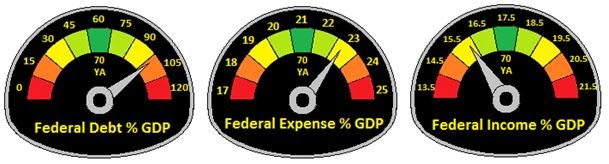
One thing that becomes apparent when we consider the 70 YA of taxes and expenses is that, contrary to conservative opinion, the size of government has not grown out of control.  It is only 2% of GDP larger than the 70 YA, and well within the highs and lows of the last 70 years.  It is the combination of expense overruns and low taxation that creates our swelling deficits.  We often hear about the need for a balanced budget, which is also an overstatement.  Spending has outpaced income for all of the last 70 years, with just a few exceptions, Clinton's administration being the last.  The average annual deficit has averaged about 3.3% of GDP, just slightly below the 70 YA rate of inflation at 3.9%.

What about unemployment?  This figure is still quite high, and unemployment is a huge problem in America, right?  To the contrary, this appears to be false, because overall employment per capita (workforce) is at a comfortable 49.2%, a full 3.78% above the 70 YA.  That is to say, more Americans are at work today than most of the 70 YA, and more than any time prior to 1988.  Unemployment is a measure of change in employment.  In this case, we are comparing to the absolute highest overall decade of employment in U. S. history (1996-2006).  So, contrary to Tea Party rhetoric, America is not living off the government, and we do not need to be starved in order to go to work.  We are not under employed.  We just happen to be below maximum employment.

So, if more of us are working, why don’t we feel more successful?  We should, because our average household income of $68,000 is far better than the 70 YA of only $52,800 (adjusted to 2012 dollars).  Perhaps that is why Barack Obama had the gall to say, “The middle class is doing fine.”  On average, we make about 28% more than our parents did.    

So, let’s review:  We make more money than our parents did, and more of us have jobs than our parent’s generation.  We are taxed less than our parents, and the government spends slightly more on programs than it did for our parents.  Maybe it is time for us to think hard about the real debt problem - modern greed.  Tell your congressman to raise taxes, and find sensible ways to cut the budget without taking benefits from the poor.  This is the “balanced approach” Obama spoke of last year.  The trouble with congress at this moment is that it doesn't want to do the right thing.  They certainly don't want everyone to know the President was right all along.

(Special thanks to my son, Marcel Fiore, for creating the dashboard gauges.)

Tony F.

2013

Monday, July 1, 2013

The Most Ridiculous Bill Yet

Last week the Senate approved an immigration reform bill that was announced with upbeat fanfare by the media.  Liberal anchors called it a great compromise on the path to citizenship, and conservative anchors called it a much needed border security measure.  Everyone was pleased, except people like me.  I could only describe this bill with one word – ridiculous.


Immigration reform has been promised by Democrats for many years, in the form initially referred to as the Dream Act.  The whole idea is that we should allow the best immigrants – those who work hard, study, graduate school, produce, and assimilate themselves into society - the right to American citizenship.  It makes America stronger, healthier, and more productive.  I wrote about this idea in February.  For the longest time, conservatives would not engage this conversation.  They said a path to citizenship would only encourage more illegals to come running across the border, referring to them in the manner of sub-human pests.  It wasn’t till the election of 2012 that conservatives realized that they were being beaten by and needed to earn more of the Hispanic vote.  Republicans would not dream of immigration reform until they realized they needed do something to earn the favor of minority voters.  So the conversation was begun.


The result is a cobbled mess of legislation that doesn’t reform immigration at all.  Instead, it has turned into a military spending bill.  With the effort of Republicans, so-called immigration reform has been placed on hold until we spend $38 to $58 Billion on increased border security.  Reform kicks in after the money is spent and someone magically announces that the job of border security is complete, although the point of completeness is not defined.  Furthermore, the bill does not define where the billions are supposed to come from.  Didn’t we just fight our way through budget sequestration to save approximately $50 Billion, supposedly shrinking government and staving off certain bankruptcy?  Wasn’t reduction in government spending the absolute most important agenda on the right side of the aisle?  Wait, aren’t those the same guys who decided to spend billions of new funds on border security?  As it turns out, there is another agenda that is stronger than winning minority votes, and it is winning the favor of defense contractors.  Clearly this bill has taken a turn toward big business while ignoring the Hispanic vote that Republicans so badly need.  It’s ridiculous.

For conservatives there is still a bright side.  We don’t need to spend that money at all.  In fact, when the next debt ceiling debate comes to a head, conservatives can use it as leverage to completely kill the Immigration Reform Bill and save us Billions again!  So, for those voters who have absolutely no long term memory, it will appear that the conservatives did just the right thing at the right time by killing expenditures that were brought up by conservatives in the first place.  It’s just brilliant.  In fact, the House has already promised to disassemble the entire bill and throw it out piece by piece.  Do you suspect that they intend to come up with something better?  I certainly don’t.  They most likely will come up with something even more ridiculous. 

So let’s all give a hearty hip, hip, hooray for the bill that does absolutely nothing to improve immigration or the path to citizenship, while first requiring that it cost tens of billions, if the money is ever appropriated, which it most likely will not be.  I guess the most baffling question for me is how the media, who is usually so deliciously inquisitive about these things, bought into this joke of a package.  Do they get a piece of the billions too? Ridiculous.


Tony F.   2013

Monday, May 27, 2013

What is your bias?

Over the course of 40 years worth of studies, Gallup Polls has determined that we are all biased, particularly when it comes to politics.  For example, after every election year, poll results overwhelmingly show that the party that lost an election always has a dim outlook for the future while the party that won the election always feels that everything is looking up.  In addition, when a politician is accused of an indiscretion, the opposing party is always shocked and appalled, while the party in power always sees it as a minor misstep.  The only true way to know a serious scandal is if all parties isolate themselves from the accused.


In this context, let’s look at the three “scandals” that hit the Obama administration over the last month.  First of all, consider the use of the word “scandal”.  By definition, scandal refers to the violation of morality or propriety.  Conversely, the accusation of a scandal that is not proven to be true is, in itself, a violation of morality and propriety by the accuser.  It is in this environment that Newt Gingrich recently cautioned Republicans to go easy in order to avoid possible political overreach.  According to Gingrich, the Lewinsky scandal of 1998 was overreach, ultimately resulting in sympathy for Democrats and disdain for Republicans.  As it stands, Obama’s current approval rating sits at a comfortable 53 percent.  

Let’s take a quick look at each of the big 3 and consider some of the facts:

 1.  Justice Department spying of Associated Press - After Republicans opened the door to wiretapping and other questionable means of fighting the war against terrorism, Republicans also demanded that the White House monitor and stop security leaks to the AP.  Now we find that the Obama administration is slammed for doing exactly what his critics suggested.

           2.  Benghazi attack  – The question here is exactly what the accusation is.  Is there a problem with the perceived cover up, or a problem with the lack of response to the attack, or both?  Since the accusation is not clear, it appears that conservatives are just groping and hoping for something to stick.  Although we all agree that this is a tragedy, and mistakes were made, it is hard for a fair minded person to define the whole event a scandal.  As it stands, Hilary Clinton and Susan Rice have already taken most of the heat for their involvement, which makes it look like a witch hunt aimed at female Democrats.  I assume this is not the impression Republicans were trying to make but it is there.


       3.  IRS targeting of Conservative groups – Yes, the IRS has admitted to targeting of conservative groups, making it difficult for them to get 501c4 tax exempt status, but additional scrutiny of political groups is exactly what the IRS was supposed to do.  This is because a group engaged in politics is disqualified from tax exempt status.  This burden of scrutiny was given to the IRS in January 2010 after the conservative group Citizens United was given leeway by the Supreme Court, modifying the tax law to allow 501c4 status to entities engaged in politics “as long as politics is not their primary activity” – a poorly defined criteria.  After this ruling, congressional members asked the IRS to carefully scrutinize new applications.  Of course, without clear criteria, the IRS was able to act as they saw fit, creating the obvious indiscretions.  Interestingly, Obama demanded the resignation of IRS Commissioner Steven T. Miller despite the fact that he only served the position for 8 months.  Congress still cannot tie the actions of the IRS to the White House, but they continue to try.  


You may argue that the summaries above are somewhat forgiving of a tyrannical administration that is slowly violating our civil rights.  Perhaps that is my bias, but I invite you to check your own bias.  Did you vote for or against Obama?  How or where did you hear the news?  Did the source of the news suggest that you should be outraged?  Did the source suggest this should be the end of Obama?  Even Newt Gingrich understands that these overblown suggestions are produced by political entertainers who are in the business of firing up their conservative audiences, sometimes successfully, but evidently not so much this time.  The public outrage that was suggested only seems to exist in the mind of the commentators.  With that, we have a duty to check the facts.  In today's information age, fact checking has become easier than ever before.

It is undeniable that each of us sees the world from a certain degree of bias.  This bias depends greatly on our life experiences – for example, how we were raised, or the opinions of our parents and friends, or the media outlet that we listen to.  Although most of us would like to believe that we are fair minded and unbiased, we will be much more intellectually honest if we all admit that we are prejudiced.  Furthermore, we need to recognize that others around us are the same way, but not necessarily on the same side.  Until we check the facts, we really don't know anything except our bias.


Tony F.   2013

Saturday, May 18, 2013

As the Crow Flies


It takes 1 hour and 45 minutes to travel the 75 mile route from Boulder to Winter Park, CO.  In a typical car this trip equates to about 3 gallons of gasoline and about 13 lbs of newly released exhaust pollutants.  This is a shame, particularly since Boulder and Winter Park are in fact only 27 miles apart, nearly 1/3 the distance of the highway route!  Also shameful is the fact that a more direct path from the Front Range to Middle Park has existed since the mid 1860’s, first in the form of wagon passes, later upgraded to Rollins Pass.  Rollins Pass was once accessible in a family sedan, but was closed to all traffic in the mid-1960’s because no money was allocated to maintain or improve the route.  Even now, residents of Boulder County continue to fight the potential re-opening of Rollins Pass, citing environmental protection in an area where a railroad and highway had existed for 100 years.

Why does this matter?  It matters because the Boulder/Winter Park example is one of a great many modern highway routes through Colorado that force us to take the long road to get over short distances.  Instead of taking the best route, we widen, improve, and maintain much longer stretches of highway.  This wastes time, maintenance costs, resources, and most importantly a great deal of fuel over the life of the highway.  In Colorado, we tend to think we are protecting the mountain by not crossing over it.  Instead, we travel all the way around the mountain and pollute the entire range with exhaust. 

You may assume that the routes we currently take were chosen due to their overall superiority.  Perhaps the scenery was better, more people tended to travel that way, or it was a less expensive route to maintain.  Although each particular highway has a unique history, this is generally not true.   Let’s explore the possibility that currently popular solutions are not necessarily the better ones: 

It is a little known fact that the QWERTY typing keyboard is NOT the most efficient typing layout.  During the invention and development of mechanical typewriters, the keys might have been laid out to place the most important keys in the home row, but this increased the likelihood that the hammers would tangle with each other as they made their way to and from the paper.  The most used keys were actually placed away from home row to slow the typist and give the mechanical arms a greater chance to recoil.  The positioning of the QWERTY keys was therefore based on an inefficient mechanical principal that no longer exists, but we are not likely to improve it because this is how we have learned to type.

The English dictionary and alphabet is a conglomeration of several languages and several rules of spelling, thus making it arguably the least efficient language in the world.  The spelling of each word in the English language must be memorized.  By comparison, Korean is so efficient that there is no such thing as a spelling bee in Korea.  Their writing system is perfectly phonetic.   This is unfortunate because English is the dominant world language, spoken in more countries than any other, and sapping an unnecessary amount of brain power.  The spelling issues could be corrected by creating a phonetic alphabet, but it is fair to guess we will not improve the alphabet either.


This is green.
This blog post is intended to illustrate two points: 1) We do not make the most efficient choices, so there is no logic in assuming that the dominant choice is the best choice, and 2) In an attempt to protect our environment, we create scenarios that are even worse.  In his book "The Conundrum", David Owen presents a wide variety of examples where we truly misunderstand the notion of efficiency, sustainability, and being "green".  He argues, quite convincingly, that a dense high-rise city is far more efficient than a spacious tree lined suburb.  In one of his most compelling arguments, he states that the greatest problem with environmental efficiency is the environmentalists themselves.  This is what stands in the way of wind power, hydro power, and solar power as we attempt to protect our views and pristine habitats.  If we are to get any cleaner, greener, or more responsible toward our environment we need to stop taking the long road in the name of environmental protection.  The most efficient way to get there is as the crow flies.

Tony F.  2013

Saturday, May 4, 2013

Climate Change be Dammed

Some time within the next 10 years a majority of the world population will come to the consensus that Global Climate Change is occurring, and is not preventable.  It is also likely that within the next 10 years enough data will be collected to create a more realistic model of how we will be affected which could in turn lead to policy change.  In the absence of such consensus, computer models, and policy, we have the opportunity to make some wild predictions as to what Global Climate Change may look like over the next 50 years.  Here is mine:

2010-2020  Due to steady funding and innovation in fossil fuels, hydrocarbons will continue to feed our energy needs.  Political and social pressures will influence a decline in energy and water consumption but population growth maintains a constant need for resources.  Alternative energy will continue to expand slightly with political boosts, but will have a continuing disadvantage due to the low cost of fossil fuels.  Weather will become more extreme.  Droughts will last for increasing periods followed by tragic floods.


2020-2030  On going patterns of long drought followed by flood will influence a growing need for water and storm management.  Extreme drying and subsequent flooding cause a noticeable loss of fish and wetland habitats.  The lack of water during the growing season stresses food production.  Grazing patterns of livestock become more tightly regulated in an effort to reduce over grazing and desertification.  Residential lawns and greenbelts are slowly replaced by rock beds, regional plants, and xeric landscapes.  Public sentiment shifts toward new dams and reservoirs to satisfy the need for water storage, flood prevention, food production, and hydro energy.

2040-2050  Dam building projects are underway.  In order to increase the payback on dam costs, tax incentives are removed from fossil fuel production to increase energy costs and the value of hydro energy.  For the first time, alternative energy becomes competitive.  Energy and water efficiency continue to grow in popularity due to rising water and energy costs.  Innovations in agriculture bring more efficient crops.  Building codes and master development plans encourage dense, multi-use communities where water use and energy efficiency are the focus.


2050-2060  Fossil fuel production falls behind alternative energy after a significant boost from hydro.  Despite the increased intensity of storms, multiple water reservoirs keep flood waters and snow melt at bay while rationing water flow at a more consistent rate for irrigation, hydro-electricity, and riparian habitat.

Do you notice a theme here?  Carbon emissions will not be the driving force of policy decisions over the next 50 years due to a lack of alignment of public opinion.  Water supply and management will instead be the force that shifts public sentiment.  Although dam building is not politically popular right now, we will eventually learn that our very survival depends on water storage.  We will realize that the long range answer to climate change is dams more so than any other solution.

During America's industrial expansion from 1920 to 1960, a great number of dams were built largely due to shortage of water near growing populations.  A great many of these dams enabled rivers to flow more consistently, water supplies to be more predictable, farm land to be more productive, and energy to be generated without carbon emissions.  It was a win in many ways, and we continue to flourish as a result.  In recent years, we have become so much more focused on minor environmental issues that we have completely reversed trend.  Despite this, when water needs affect us at home we will demand swift action.  There will be a day when the public cries for more dams and supply ducts to provide fresh water for human use instead of allowing it to flow out to sea.

Tony F.  2013    

Sunday, April 7, 2013

Free to be ill

Without argument, the U.S. is intended to be a free country, yet arguments abound as to how free we really are, as well as how free we really should be.  To illustrate the argument, the City of New York recently attempted to regulate our health by eliminating large sugar-filled drinks – a move that caused uproar from the conservative right, declaring that our government was trying to control our every move and deny us our freedom.  In that vein, should we be free to smoke cigarettes, drink excessive alcohol and sugar, over eat, and not exercise while still being guaranteed access to affordable healthcare?  In recent years, the answer to that question has become “yes”.  As America casts their vote to the left, we make the statement that we have the freedom to be cavalier with our health while expecting a safety net when our health fails.  So where do we find the balance between affordable health care and the freedom to be ill?

The answer to this question has already been determined.  The consequences will be coming soon, and it will come in a surprising way.  Because we have asked our government to force insurance companies to cover everyone regardless of the risks, insurance companies will respond by raising the rates that corporations pay to cover their employees.  Most corporations will not immediately force all employees to pay a greater share of healthcare costs right away because they want to preserve employee retention and morale.  Instead, corporations will find ways to control their risks.  They cannot fire unhealthy employees, and they cannot deny their healthcare.  The only thing they can do is to incentivize employees to get healthier.  Employees are now being asked by their employers to take voluntary health screenings.  We are free to decline the health screen, but we will pay a higher share of our insurance out of our paycheck if we make this choice.  If we take the health screen and are found to be healthy, our insurance costs remain the same or may even be reduced.  If we take the health screen and are found to be ill or at risk, we then have the option to modify our behavior or take a cut out of our paycheck to cover insurance.
  
As we continue to rely on our employers to provide our health insurance, eventually we will be screened, prodded, sampled, questioned, and then asked to modify our behavior to make us healthier.  This may mean quitting smoking, or taking alcohol abuse classes, or losing a specified amount of weight, or hitting a certain target of cholesterol reduction, or even keeping a workout log.  We will be asked to do this for two reasons; one, because our employer cares about our health, and two, because our employer cares about the cost of our healthcare.  Our health will not be defined by how we feel or what a doctor thinks.  Health is more likely become a matter of hitting certain standards determined by insurance companies.  Either way, our health will be regulated, or at least incentivized by the people who are in control of our prosperity.

So, what is the difference if we are regulated by our government or if we are regulated by our employer?  Not much, except that we can hold a corporation liable or change employers if we believe we are treated unfairly.  It is reasonable to say this is the less frightening scenario.  Either way, the state of our health and the things we do to our health will be someone else’s business.  We will no longer be in the position to eat as we want, drink as we want, and relax as we want.  We will be charged by our employers to live a healthier life or pay the consequences.  For better or worse, we are no longer free to be ill.

Tony F.  2013

Wednesday, March 13, 2013

Leverage


I know a man who represents the classic American story.  He was the son of an immigrant family who struggled to pay rent from month to month.  He loved cars from a very young age, and enjoyed working on them and talking about them.  He is an energetic guy.  In current day, he might have been diagnosed as having ADHD, but his family just diagnosed him as having “ants in his pants”.  He was unrefined - he cussed terribly, smoked cigarettes, refused to cut his hair, did poorly in school, and was generally expected not to do well.


When he was in his early 20’s, he was the passenger in a serious car accident.  The car he rode in was smashed by a cement truck, causing dramatic injury to his head and face.  He was permanently scarred.  He later received $50,000 as a settlement from the cement company.  Unlike many Americans, he did not reward himself with the best new car he could afford.  He did not throw a party, nor flaunt his new money.  In fact, he did not waste a penny.  He invested every dollar in used cars for resale.  After selling those cars for a small profit, he did it again, and again, and again.  He was passionate about his work.  He sometimes rose at 4:00 am to be the first in line to buy more cars, and then he would work late into the evening to prepare his cars for the next day. 

Fast forward 15 odd years and you find that he is a millionaire, owning the largest used car dealership in his city - true story!  This story is the coming together of four key ingredients – knowledge, discipline, hard work, and leverage.  Without any one of these ingredients, this story would not have been possible.  The leverage came as a result of a tragic accident from which he encountered a windfall of $50,000.  Many of us would have spent that leverage, or invested it in risky enterprises that won't pay off, but he didn't.  This fact, combined with his other three attributes, enabled my friend to make a over million from his leverage.    Surprisingly, this man is not the only person I know who has utilized leverage in such an extraordinary way.   I know several people of this ilk, and all of them share the same unique and respectable qualities.

As you recall, some of my blog posts suggest higher taxes on the wealthy.  Conservatives label this attitude as “class warfare”.  I’m writing this post is to explain why I take such a position despite my respect for these great people.  The key here is leverage.  As you have read, our true life hero has taken $50,000 in leverage and very carefully increased it to over a million dollars.  I respect this man, and I would not take a single dollar from him.  That said, I do have a different attitude regarding his future earnings.  Because of his hard work over the last 15 years, he currently has hundreds of thousands in leverage, which is likely to earn him his next million in just a few years.  Once he’s earned that million, the added millions can come with comparably little work.

Does he deserve to be wealthy?  Sure!  Does he deserve to continue getting wealthier?  Without a doubt!  Is it possible that he didn't earn every dollar honestly?  Well, he is a used car salesman after all, but that's not my point here.  The heart of the question here is whether he deserves to become wealthier at the highly accelerated pace afforded him by his leverage.  Contrary to trickle-down theory, the wealthy do not create jobs or boost the economy at a pace in keeping with their increased wealth.  A reasonably disciplined person of wealth is likely to double his wealth every 5 years while not working quite as hard as he had worked to earn his first million.  This is the very reason why the wealthy are supposed to be taxed at a higher rate than the middle class.  As it stands, though, they are not.  Most wealthy do not pay much in payroll taxes or income taxes.  The taxes that they do pay, corporate tax and capital gains, are assessed at a lower percentage than the taxes paid by the middle class.  Consequently, over the past 12 years, the wealthy have amassed added wealth at an extremely accelerated pace while average middle class earnings have been reduced.

Is higher taxation the same as class warfare?  Absolutely not.  In fact, it is not even an attempt to redistribute wealth, which implies an effort to take from the rich.  Leveraged taxation is simply an effort to regulate the pace in which the wealthy continue to grow wealth.  It does not make them less rich.  My friend will continue to grow wealth because he takes the right steps to earn.  I only argue that he should get wealthier at a slightly slower pace than his increased leverage will allow.

Tony F.  2013